Chard

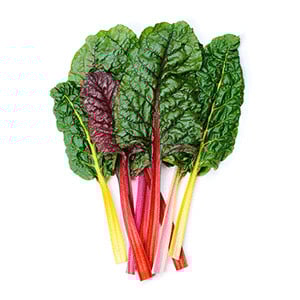
Chard
Beta vulgaris subsp. vulgaris
Plant family
Goosefoot family (Chenopodiaceae)
Also known as
Swiss Chard
Season Overview
Propagating
Planting
Harvest
J
F
M
A
M
J
J
A
S
O
N
D
Details


Light requirement
Semi-shaded

Water requirement
Wet

Soil
Light (sandy)

Nutrient requirement
Medium

Plant distance
30 cm

Row spacing
40 cm

Seeding depth
1 cm
Instructions
The season for this plant is over. The following instructions are for the next season.
Mid of March

Propagating
End of March

Planting
End of March

Transplanting
Description
Biennial goosefoot with two groups of varieties: stem or ribbed chard and leaf or cut chard. Stem chard forms a very large leaf vein that can be prepared like asparagus. Leafy chard forms a much smaller leaf vein, but large leaves that can be used like spinach or raw as a salad ingredient when young.
Origin:
Coastal regions of the Mediterranean
Growing tips
When sowing, chard likes humus and nutrient-rich soil and should then be kept moist. After germination, it is advisable to remove seedlings that grow too densely. Chard tolerates light frost and can remain outdoors in mild winter regions. Chard leaves can be harvested continuously from approx. 2 months after sowing, chard stems after approx. 3 months. If only the outer leaves are removed and the plant is watered, the chard will grow back. A cultivation break of 3-4 years should be observed in relation to other goosefoot plants.

Companion Plants
Bean (Dwarf bean)
Bean (Runner bean)
Broccoli
Brussels sprouts
Cabbage (Cabbage)
Cabbage (Savoy cabbage)
Carrots
Cauliflower
Collard greens (Kale)
Collard greens (Tuscan kale / Dinosaur kale / Palm tree kale)
Common marigold
Kohlrabi / German turnip / Turnip cabbage
Lettuce (Radicchio / Italian chicory)
Napa cabbage / Chinese cabbage
Oregano
Pak Choi
Radish
Radishes
Rutabaga / Swedish turnip
Savory
Sunflower
Turnip

Antagonistic Plants
Diseases
Downy mildew
Pests
Beet fly
Aphids