Onion

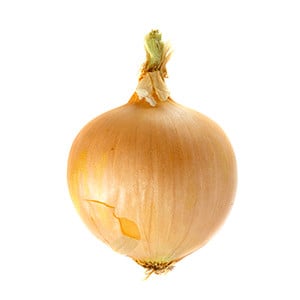
Onion
Allium cepa
Plant family
Amaryllis family (Amaryllidaceae)
Season Overview
Propagating
Planting
Harvest
J
F
M
A
M
J
J
A
S
O
N
D
Details


Light requirement
Sunny
Water requirement
Moist

Soil
Medium (loamy)
Nutrient requirement
Medium

Plant distance
15 cm

Row spacing
20 cm

Seeding depth
1 cm
Instructions
The season for this plant is over. The following instructions are for the next season.
Beginning of January

Propagating
Beginning of January

Weeding
Every week
Beginning of February

Transplanting
Description
Perennial amaryllis plant, which in the first year forms the bulb as a storage organ. Onions include several groups: Leek and spring onions, shallots, summer or kitchen onions, and vegetable onions, all of which differ greatly in growth habit. Furthermore, a distinction is made between "summer", "spring" and "winter" onions. Our usual edible onion is called "winter onion" when it is sown in the fall, cultivated over winter, ripens the next spring and then harvested. Harvesting is a little earlier, but they become very soft and can hardly be stored. Therefore, the edible onion is usually sown or set as a "summer onion" in the spring. Then they can be harvested from July for direct consumption or from August to October for storage. There are also special cultivars of 'Allium cepa' as spring onions. They do not form bulbs, but long, soft stems and grow quickly. Due to the storage organ, the onions are adapted to rainfall fluctuations and drought. Nevertheless, to harvest large onions need a lot of water.
Origin:
Probably from Central Asia
Growing tips
A distinction is made between seed onions and onion sets. Summer, kitchen and vegetable onions are usually planted as onion sets in spring. The onion sets are only planted deep enough to just cover them with soil. Sowing in spring is also possible, the onions are usually somewhat smaller at harvest and can be planted as onion sets the following year. It is also possible to grow seedlings in planting trays. The seedlings are then planted in the bed as soon as the 3rd or 4th leaf is visible and no more heavy frost is expected. Harvest as soon as the leaves snap and turn yellow by themselves and the leaf base dries up. To do this, you should wait for a dry, sunny day and allow the onions to dry out before storing them.

Companion Plants

Antagonistic Plants
Artichoke
Asparagus
Bean (Broad bean / Faba bean / Field bean)
Bean (Dwarf bean)
Bean (Runner bean)
Broccoli
Brussels sprouts
Cabbage (Cabbage)
Cabbage (Savoy cabbage)
Cauliflower
Collard greens (Kale)
Collard greens (Tuscan kale / Dinosaur kale / Palm tree kale)
Jerusalem artichoke / Topinambur
Kohlrabi / German turnip / Turnip cabbage
Leeks
Lovage
Napa cabbage / Chinese cabbage
Pak Choi
Pea
Pumpkin / Squash
Radish
Radishes
Soybean
Diseases
No diseases
Pests
Thrips
Stem borers
Leaf-miner flies
Onion fly
Wireworms