Knoblauch

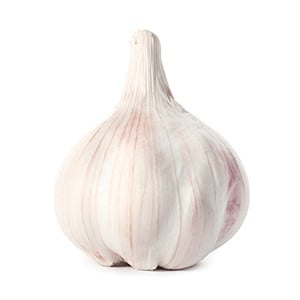
Knoblauch
Allium sativum
Pflanzenfamilie
Amaryllisgewächse (Amaryllidaceae)
Saisonübersicht
Aussaat
Ernte
J
F
M
A
M
J
J
A
S
O
N
D
Details


Lichtbedarf
Sonnig

Wasserbedarf
Feucht

Boden
Mittelschwer (lehmig)

Nährstoffbedarf
Niedrig

Pflanzabstand
10 cm

Reihenabstand
25 cm

Saattiefe
4 cm
Anleitungen
Die Saison für diese Pflanze ist vorüber. Die folgenden Anleitungen sind für die nächste Saison.
Anfang September

Direktsaat
Anfang September

Jäten
jede Woche
Ende Dezember

Ernten
Beschreibung
Knoblauch ist ein ausdauerndes, frosthartes Zwiebelgewächs, das ein- bis zweijährig kultiviert wird. Es gibt zwei verschiedene Unterarten zu unterscheiden. Als Hardneck (Allium sativum var. ophioscorodon) bezeichnet man Knoblauch, der einen sehr harten Stängel in der Mitte bildet, an dem die Zehen außen herum liegen. Dieser ist auch der "Urknoblauch" aus dem die verschiedenen Sorten von heute gezüchtet wurden. Er ist auch teils unter dem Namen Winterknoblauch bekannt, da er sehr kältetolerant ist und im Herbst eingepflanzt wird. Er braucht außerdem den Kältereiz, um in die Scheinblüte zu gehen. Er bildet am Ende des Blütenschafts eine Knospe in der keine Samen, jedoch kleine Brutzwiebeln heranwachsen. Die Lagerfähigkeit ist mit etwa 4 bis 6 Monate geringer, aber dafür ist der Hardneck Knoblauch besonders aromatisch und sehr vielfältig in seinem Aroma. Der Softneck Knoblauch (Allium sativum L. var. sativum) hingegen, bildet nur Laub aus und hat daher keinen harten Stängel in der Mitte. Er wird im Frühjahr gesetzt und wird auch eher in wärmeren Gegenden angepflanzt. Der Softneck Knoblauch ist etwas milder im Geschmack und ca. 10 bis 12 Monate haltbar.
Herkunft:
Zentralasien
Anbautipps
Knoblauch bevorzugt lockere, humose Böden ohne Staunässe in sonniger, offener Lage. Er gedeiht am besten bei milden Temperaturen (12-24°C), die Knollenbildung wird bei Temperaturen über 30°C gehemmt. Es werden einzelne Zehen oder Brutzwiebeln (Bulbillen) gepflanzt. Die Brutzwiebeln setzt man nur ca. 2 cm tief in die Erde. Bei Hardnecksorten kann man die Scheinblüten bei einigen Pflanzen auch wegschneiden, dass all sie alle Energie in ihre Knollen stecken. Und nur ein paar wenige Pflanzen auch Bulbillen ausbilden lassen, um sie im Herbst wieder zu stecken. Die Brutzwiebeln bilden je nach Sorte im nächsten Jahr dann schon fertige Knoblauchknollen oder sogenannte Rundlinge. Diese können ebenfalls verwendet werden oder einfach im nächsten Jahr nochmal gesetzt werden, in dem sie dann ebenfalls die typische Knolle ausbilden. Die Ernte erfolgt im Juli, sobald sich das Laub zu etwa 2/3 bräunlich verfärbt hat.

Gute Nachbarn

Schlechte Nachbarn

Krankheiten
Eckige Blattfleckenkrankheit
Schwarzfleckenkrankheit
Rotfleckenkrankheit
Grauschimmel
Falscher Mehltau
Latenter Knoblauchvirus
Zwiebel-Gelbstreifen Virus
Schädlinge
Stängelälchen
Zwiebelfliege