Bean (Dwarf bean)

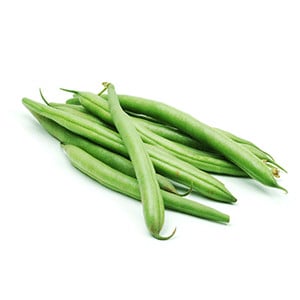
Bean (Dwarf bean)
Phaseolus vulgaris var. nanus
Pflanzenfamilie
Legumes (Fabaceae)
Saisonübersicht
Aussaat
Ernte
J
F
M
A
M
J
J
A
S
O
N
D
Details


Lichtbedarf
Halbschattig

Wasserbedarf
Feucht

Boden
Mittelschwer (lehmig)

Nährstoffbedarf
Mittel

Pflanzabstand
10 cm

Reihenabstand
40 cm

Saattiefe
3 cm
Anleitungen
Die Saison für diese Pflanze ist vorüber. Die folgenden Anleitungen sind für die nächste Saison.
Mitte Mai

Sowing
Mitte Mai

Weeding
jede Woche
Ende Mai
Thinning
Beschreibung
The bush bean is a cold-sensitive legume. Since bush beans belong to the legumes, they can go into symbiosis with nitrogen-fixing bacteria and are therefore a good preculture for crops requiring nutrients. The different varieties vary in bean size and color.
Herkunft:
Central America
Anbautipps
Direct sowing in clumps or rows is possible until mid-July. Stability is increased by sowing in clumps and by regularly hoeing around the plants. During the main harvesting period, you can harvest the ripe pods every three days. If you cover the seedlings with fleece or foil, early sowing is possible, even if the temperatures are still low. Nitrogen fertilization is not necessary as the nodule bacteria fix nitrogen on the roots.

Gute Nachbarn
Asparagus
Beetroot
Black salsify
Blackberry / Brambles
Borage
Broccoli
Brussels sprouts
Cabbage (Cabbage)
Cabbage (Savoy cabbage)
Caraway / Meridian fennel / Persian cumin
Cauliflower
Celery (Celeriac / Celery root)
Celery (Celery)
Chard
Collard greens (Kale)
Collard greens (Tuscan kale / Dinosaur kale / Palm tree kale)
Common marigold
Cucumber / Gherkin
Dill
Kohlrabi / German turnip / Turnip cabbage
Lettuce (Lettuce)
Lettuce (Radicchio / Italian chicory)
Napa cabbage / Chinese cabbage
Nasturtium
Oregano
Pak Choi
Physalis
Potato
Radish
Radishes
Rhubarb
Rutabaga / Swedish turnip
Sage
Savory
Spinach (Summer)
Strawberry
Sunflower
Tarragon
Turnip

Schlechte Nachbarn

Krankheiten
Keine Krankheiten vorhanden

Schädlinge
Aphids
Land snails