Mangold

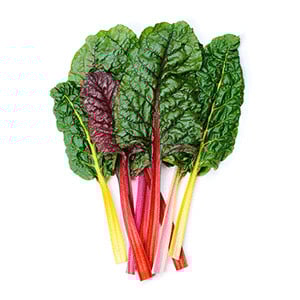
Mangold
Beta vulgaris subsp. vulgaris
Pflanzenfamilie
Gänsefußgewächse (Chenopodiaceae)
Saisonübersicht
Voranzucht
Pflanzung
Ernte
J
F
M
A
M
J
J
A
S
O
N
D
Details


Lichtbedarf
Halbschattig

Wasserbedarf
Sehr feucht

Boden
Leicht (sandig)

Nährstoffbedarf
Mittel

Pflanzabstand
30 cm

Reihenabstand
40 cm

Saattiefe
1 cm
Anleitungen
Die Saison für diese Pflanze ist vorüber. Die folgenden Anleitungen sind für die nächste Saison.
Mitte März

Propagating
Ende März

Planting
Ende März

Transplanting
Beschreibung
Zweijähriges Gänsefußgewächs mit zwei Sortengruppen: Stiel- oder Rippenmangold und Blatt- oder Schnittmangold. Stielmangold bildet eine sehr große Blattrippe aus, die wie Spargel zubereitet werden kann. Blattmangold bildet eine sehr viel kleinere Blattrippe aus, dafür aber große Blätter, die wie Spinat oder im jungen Stadium roh als Salatzusatz verwendet werden können.
Herkunft:
Küstenregionen des Mittelmeers
Anbautipps
Mangold freut sich bei der Aussaat über humose und nährstoffreiche Erde und sollte anschließend feucht gehalten werden. Nach der Keimung empfiehlt es sich, zu dicht wachsenden Keimlinge zu entfernen. Mangold verträgt leichten Frost und kann in wintermilden Regionen im Freien bleiben. Blattmangold kann fortlaufend ab ca. 2 Monaten nach Aussaat, Stielmangold nach ca. 3 Monaten geerntet werden. Wenn man dabei ausschließlich die äußeren Blätter entfernt und die Pflanze gießt, wächst der Mangold wieder nach. Eine Anbaupause von 3-4 Jahren zu anderen Gänsefußgewächsen sollte eingehalten werden.

Gute Nachbarn

Schlechte Nachbarn

Krankheiten
Falscher Mehltau
Schädlinge
Rübenfliege
Blattläuse