Chives

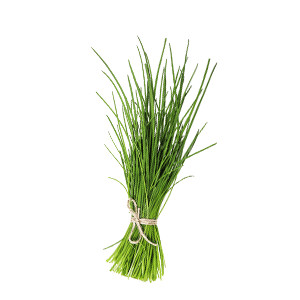
Chives
Allium schoenophrasum
Pflanzenfamilie
Amaryllis family (Amaryllidaceae)
Saisonübersicht
Voranzucht
Pflanzung
Ernte
Ernte
J
F
M
A
M
J
J
A
S
O
N
D
1. JAHR
FOLGEJAHRE
Details


Lichtbedarf
Sonnig

Wasserbedarf
Sehr feucht

Boden
Mittelschwer (lehmig)
Nährstoffbedarf
Mittel

Pflanzabstand
5 cm

Reihenabstand
25 cm

Saattiefe
0.5 cm
Anleitungen
Anfang März

Transplanting
Mitte März

Harden
Ende März

Planting
Beschreibung
Chives are a perennial spice plant from the amarylis family. It is hardy and grows - depending on the variety - 30 to 100 cm high.
Herkunft:
Alpine, as well as boreal and subarctic regions of the northern hemisphere
Anbautipps
You can sow chives directly into the bed, but we recommend pre-growing them in a seed tray. After approx. 4-8 weeks, you can plant the plants in clusters in the bed. Harvest as soon as the plants have taken root and the leaves are approx. 15 cm high. To propagate chives, you can dig up the clump (cluster of several plants) of an older plant in the fall or spring and carefully pull it apart. Then plant the divided clumps individually and cut off the cane leaves to a height of approx. 5 cm. Chives need a good supply of water in summer and should be weeded from time to time, otherwise they will be overgrown by weeds. Chives are suitable for mixed cultivation with various plants, as they reduce carrot fly, gray mold and downy mildew.

Gute Nachbarn
Blackberry / Brambles
Cabbage (Cabbage)
Carrots
Celery (Celeriac / Celery root)
Celery (Celery)
Chamomile
Common marigold
Dill
Florence fennel / Finocchio
Gooseberry
Kohlrabi / German turnip / Turnip cabbage
Lettuce (Radicchio / Italian chicory)
Melissa
Oregano
Parsnip
Raspberry
Spinach (Summer)
Strawberry
Sunflower
Thyme

Schlechte Nachbarn
Artichoke
Bean (Broad bean / Faba bean / Field bean)
Bean (Dwarf bean)
Bean (Runner bean)
Beetroot
Broccoli
Brussels sprouts
Cabbage (Savoy cabbage)
Cauliflower
Collard greens (Tuscan kale / Dinosaur kale / Palm tree kale)
Coriander / Cilantro
Cress
Jerusalem artichoke / Topinambur
Leeks
Lovage
Napa cabbage / Chinese cabbage
Pak Choi
Pea
Rosemary
Krankheiten
Keine Krankheiten vorhanden
Schädlinge
Keine Schädlinge vorhanden